Hotel accessibility requests need a clear response process, not a vague promise to “help on arrival.” When a guest asks about a room, route, communication feature or service, the hotel team should verify the relevant details, explain what is confirmed and what is still uncertain, and send the answer before arrival.
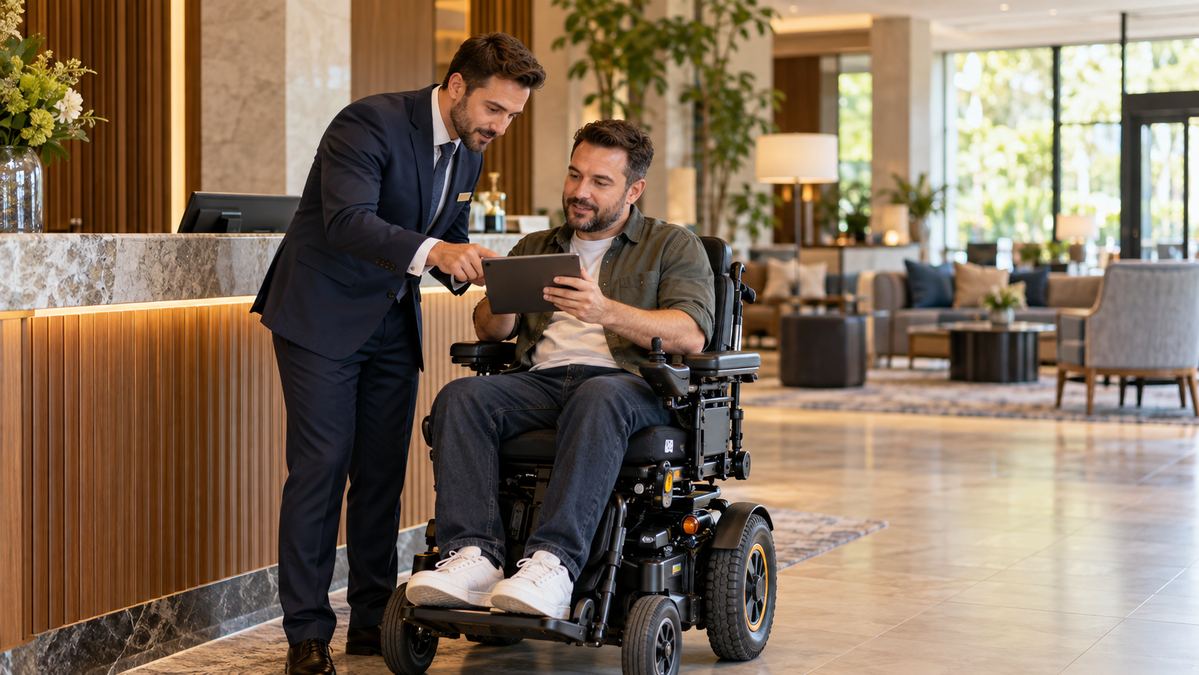
This guide gives hotel owners, reservations managers and front-desk teams a practical workflow for handling hotel accessibility requests. It helps teams answer questions clearly while avoiding assumptions about a guest’s disability or needs. It is operational guidance, not a legal opinion or a physical accessibility audit.
Why a consistent response process matters
A guest may need to know whether a particular room has a step-free route, a roll-in shower, space beside the bed, visual alerts, or another feature. A general label such as “accessible room” may not answer that person’s actual question.
VisitEngland’s guidance on accessibility information recommends clear, accurate details so visitors can make choices based on their own requirements. In the United States, the Department of Justice’s lodging rules require covered reservation services to describe accessible features in enough detail for a guest to assess whether a room meets their needs. That requirement is specific to U.S. law; hotels elsewhere must check the rules that apply in their location.
When staff give different answers, leave a request unverified, or promise a feature they have not checked, a guest may be left unable to plan confidently. A consistent process helps the hotel identify unanswered questions and pass accurate information between reservations and on-site teams.
A six-step process for hotel accessibility requests
1. Make it easy to contact the right person
Let guests ask questions through usable contact options, such as email, an accessible web form and telephone. Do not make a phone call the only way to discuss access needs. Tell guests which team will respond and when they can expect a reply, based on the hotel’s actual staffing.
If a question arrives through a booking platform, make sure the relevant hotel team can see it. A request that stays only in a third-party message thread can be missed during a staff handover.
2. Ask what feature or arrangement the guest needs
Listen to the guest’s question and clarify the practical feature they want to confirm. This might concern the route to a room, bathroom layout, bed-side space, an alerting device, dietary communication or another part of the stay.
Do not assume that one person’s needs represent every wheelchair user or every person with the same disability. Avoid requesting a diagnosis as a routine substitute for asking what information or feature is relevant. Ask only for details needed to answer the question and handle them according to the hotel’s privacy procedures and applicable law.
3. Verify the exact room, route or service
Check with the staff member who knows the feature: reservations, front desk, housekeeping, facilities, food service or another responsible team. Verify the room type the guest can actually book, rather than relying on a general property description or a photo of a different room.
- For a room question, confirm the specific room type and the features that matter to the guest.
- For a route question, check the journey from the relevant entrance through check-in to the room or facility.
- For equipment or assistance, confirm whether it is present, working, available on the guest’s dates and subject to advance notice.
- For communication or sensory questions, check what the hotel can provide and where it is available.
If a detail has not been measured or checked, do not guess. Explain what is known, what remains unverified and who will follow up.
4. Reply with specific facts and clear limits
Use plain language. State which room or facility the answer refers to, what the team verified, and any relevant limitation. Distinguish a feature that is included in the booked room from a request that still needs confirmation. If an alternative is available, describe it without implying that it removes every barrier.
A useful reply might say: “We confirmed that the room type you selected has a step-free route from the lift. The shower has a small raised threshold, so it is not a roll-in shower. We have not yet verified the bed-side clearance. Our front-desk manager is checking this and will reply by [time/date].” Replace these illustrative details with facts verified for the actual hotel.
5. Keep a concise, useful record and hand it over
Record the guest’s question, the verified answer, the source or team that confirmed it, any unresolved item and the next action. Share the information only with staff who need it to deliver the agreed service. Keep records in line with the property’s privacy and retention policies.
Make the handover usable across shifts. A note such as “accessibility request” is not enough if the next team cannot tell what feature was checked or what still needs attention.
6. Confirm important details before arrival and communicate changes
For an essential feature, confirm the relevant booking detail in writing and explain whether it is a confirmed room allocation, a confirmed facility or a request awaiting a decision. If a lift, piece of equipment or service becomes unavailable, use the hotel’s established process to contact affected guests and explain the available options.
Set a response target that fits the hotel’s staffing and reservation process. Do not present an invented response time as a universal legal requirement. Measure the hotel’s own performance and improve the handoff where replies are delayed or incomplete.
A reply template hotel teams can adapt
Subject: Accessibility details for your stay at [hotel]
Hello [guest name],
Thank you for asking about [feature or part of the journey]. We checked this with [responsible team] for [room type, facility and dates]. We can confirm that [specific verified detail].
[If relevant: We have not yet verified ____. We are checking with ____ and will update you by ____.] [If relevant: Please note that ____ is a request rather than a confirmed room feature.]
If you would like us to check another specific feature, please tell us what would help you decide whether the stay will work for you. You do not need to share more personal information than is necessary for us to answer. You can reach us by [email / accessible form / telephone].
Kind regards,
[Name and role]
[Hotel contact details]
This template is an example, not a guarantee that any particular feature is available. Adapt it to the hotel’s verified information, privacy practices and local requirements.
What should hotel managers review?
Use real enquiries to find process gaps. A simple monthly review could track:
- How many accessibility questions received a complete, verified answer.
- Which questions staff could not answer without contacting another team.
- Whether a reservation note reached the staff responsible for the stay.
- Whether published room details matched what staff confirmed.
- What guests said was still unclear, and what the hotel changed afterward.
These are suggested internal measures, not industry benchmarks. Review the patterns with staff and, where possible, with disabled people who can give feedback on the information and service. Do not assume one reviewer speaks for everyone.
Legal requirements depend on location
Accessibility laws differ by country and may apply differently to a hotel, its booking service and third-party reservation channels. For covered lodging businesses in the United States, the U.S. Department of Justice’s ADA Title III lodging rules address accessible-room reservations and information about accessible features. The Department’s guide for serving guests who are blind or have low vision also advises staff to offer information and assistance without making assumptions, and to follow the guest’s lead.
These U.S. sources do not establish the legal requirements for hotels worldwide. Check the rules for the property’s jurisdiction and consult a qualified local professional for legal, building or safety questions.
Frequently asked questions
What should a hotel ask when a guest makes an accessibility request?
Ask which feature or part of the stay the guest wants to confirm. Then verify that detail with the team responsible for the room or service. Do not replace a specific question with a broad label such as “accessible.”
Does an accessibility request mean the feature is confirmed?
Not necessarily. State whether the feature is verified and included in the booked room or whether staff are still checking availability. The distinction matters, and legal requirements vary by location.
What if staff cannot verify an answer immediately?
Say what remains unknown, name the team checking it and give a realistic follow-up time. Do not guess or promise a feature that has not been confirmed.
Should hotels handle every request only by phone?
No single contact method works for everyone. Offer a practical way to ask questions in writing as well as by phone, and make sure requests from booking platforms reach the staff who can answer them.
Make the information and service journey work together
Clear replies are one part of a hotel’s wider customer journey. The guest may need to find access information, book the right room, reach the property, use its facilities and communicate with staff. Start with one recent question: could the guest make a decision from the answer, or did the team leave them to guess?
For the website details guests need before booking, see Hotel Accessibility Information: What to Include on Your Website. For the wider business context, read What Is Accessibility? A Practical Guide for Businesses.
Hotels can also use the free EVARAACCESS Business Accessibility Journey Checker as an initial self-assessment. It helps identify questions and possible gaps; it is not a legal compliance check, certification or complete physical audit.
A reliable response begins with a simple discipline: verify the detail, explain it clearly, and follow through on what remains unanswered.
Editorial note: This practical guide is for hotel owners, reservations teams and guest-service staff. It is not an on-site assessment, legal opinion or certification. Sources reviewed 13 October 2026.