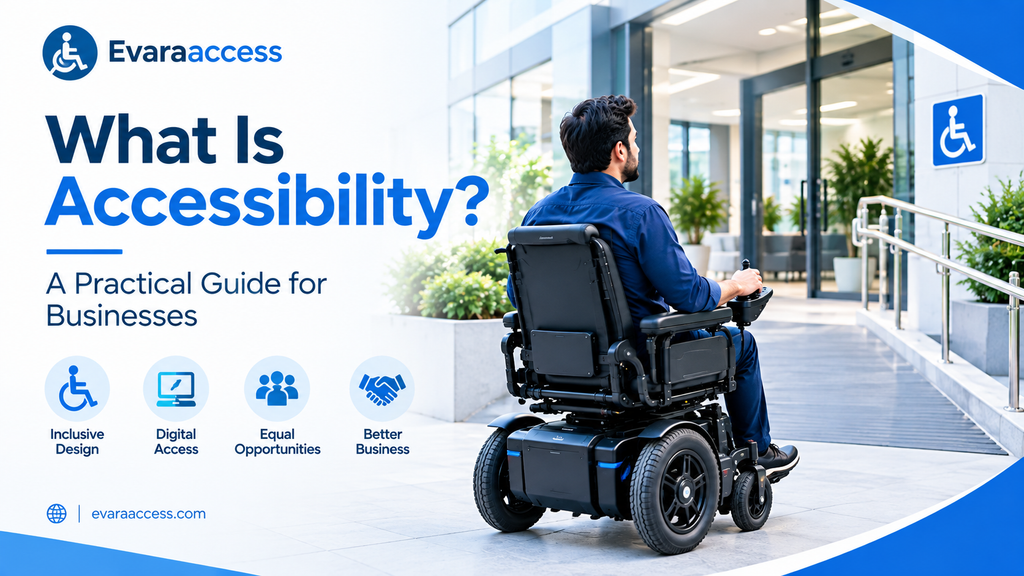
Why Accessibility Matters for Every Business
Accessibility is often discussed as a requirement, a building feature, or a digital standard.What Is Accessibility? A Practical Guide for Businesses
But accessibility is much more than that.
For a business, accessibility can influence whether a customer can discover your services, understand your information, reach your location, enter your premises, use your facilities, communicate with your staff, and complete the experience successfully.
A business may have an excellent product or service, but if customers face unnecessary barriers when trying to access it, the quality of that product or service may not be enough.
Accessibility is therefore not simply about making exceptions for people with disabilities.
It is about creating an environment where more people can participate, interact, and use a business with fewer unnecessary barriers.
Accessibility Is Part of the Customer Experience
When businesses think about customer experience, they often focus on pricing, service quality, branding, customer support, and convenience.
Accessibility should be considered as part of that same experience.
Imagine a customer searching for a hotel online.
Before making a reservation, they may need to know whether the entrance is step-free, whether an accessible room is available, whether the bathroom meets their needs, whether parking is accessible, and whether they can contact the hotel about specific requirements.
If that information is missing, the customer may have difficulty determining whether the hotel can meet their needs.
The problem may not be the hotel itself.
The problem may be the lack of accessible information.
This is why accessibility can begin long before a customer arrives at a physical location.
Accessibility Starts With Information
For many businesses, the first interaction with a customer happens online.
A person may discover a business through a search engine, social media, an advertisement, or a recommendation.
They may then visit the website to learn more.
For customers with disabilities, the website may also be where they try to determine whether the business is accessible.
Important information may include:
- Accessible entrance information
- Accessible parking
- Restroom accessibility
- Wheelchair-accessible routes
- Accessible rooms or facilities
- Contact information for accessibility questions
- Accessibility features and limitations
- Information about available assistance
- Accessible booking or appointment processes
Clear accessibility information allows customers to make informed decisions before they travel.
Businesses should not make customers guess.
A Ramp Does Not Tell the Whole Story
One of the most common ways accessibility is understood is through physical features such as ramps.
Ramps are important.
But a ramp alone does not make an entire business accessible.
Consider a customer using an electric wheelchair.
They may be able to enter through a ramp, but what happens afterward?
Can they move through the entrance?
Can they reach the reception desk?
Can they use the elevator?
Can they access the restroom?
Can they reach the area where the service is provided?
Can they move safely through the relevant spaces?
Can staff communicate with them respectfully?
Can they complete the same customer journey without unnecessary barriers?
These questions demonstrate why accessibility needs to be considered as a complete experience rather than as a single feature.
My Perspective on Accessibility
Accessibility is not something I understand only from standards or theory.
I have worked in accessibility for thirteen years, while also experiencing accessibility from the perspective of an electric wheelchair user.
This combination has strongly influenced how I understand accessibility.
From a professional perspective, accessibility involves identifying barriers and finding practical ways to reduce or remove them.
From lived experience, accessibility is also about what happens in the real world when a person actually tries to use a place, service, website, or business.
A feature may appear accessible on paper, but the real question is whether it works for the person using it.
That is why accessibility should always be considered from both a technical and human perspective.
Accessibility Is Not Only About Wheelchair Users
Wheelchair accessibility is an important part of accessibility, but it represents only one area.
People can experience different barriers depending on their individual needs.
Accessibility can involve:
Physical Accessibility
This includes buildings, entrances, pathways, parking, elevators, restrooms, furniture, and other physical environments.
Digital Accessibility
This includes websites, mobile applications, online forms, booking systems, documents, and digital services.
Communication Accessibility
People may need information to be provided in ways that are easier for them to understand, access, or communicate with.
Service Accessibility
A business may have an accessible building but still have processes that make its services difficult to use.
Workplace Accessibility
Employees with disabilities may need accessible environments, technology, communication, and workplace processes.
Home Accessibility
Accessibility is also important in residential environments, where people need to move, live, communicate, and perform everyday activities.
Travel and Transportation Accessibility
Airports, hotels, transportation systems, tourist destinations, and travel services can all create accessibility barriers when accessibility is not considered throughout the journey.
These areas are different, but they share the same fundamental goal:
Making meaningful access possible.
The Complete Accessibility Journey
Accessibility should be viewed as a journey rather than a single point.
For a customer, that journey may look like this:
Discover → Research → Contact → Book → Travel → Arrive → Enter → Navigate → Receive Service → Use Facilities → Leave → Return
A barrier at any stage can affect the entire experience.
For example, a customer may find an accessible business through search.
But if the website is inaccessible, they may struggle to obtain information.
If the website is accessible but the booking process is not, another barrier appears.
If the booking process works but the physical entrance is inaccessible, the journey stops again.
This demonstrates why accessibility should be examined across the entire customer journey.
Accessibility Should Be Planned, Not Added Later
One of the challenges businesses can face is treating accessibility as something that can be added after everything else has been completed.
This can happen when accessibility is considered only after a building has been designed, a website has been developed, or a service has already been launched.
A better approach is to consider accessibility from the beginning.
Accessibility can be included during:
- Business planning
- Architectural design
- Interior design
- Website development
- Service design
- Product development
- Customer journey planning
- Booking system development
- Staff training
- Communication planning
When accessibility is considered early, businesses have more opportunities to identify potential barriers before they become part of the finished experience.
Staff Are Also Part of Accessibility
A business can have accessible infrastructure and technology while still providing a poor accessibility experience.
Why?
Because people are part of the customer experience.
Staff members interact with customers every day.
They may answer questions, provide assistance, explain services, manage bookings, solve problems, and respond to accessibility requests.
Accessibility awareness can therefore be important for employees at every level of an organization.
Staff should understand that:
- Every disabled customer may have different needs.
- They should not make assumptions about what a person can or cannot do.
- Assistance should be offered respectfully.
- Customers should be listened to.
- Accessibility questions should be taken seriously.
- Staff should know where to obtain accurate accessibility information.
Accessibility training is therefore not simply an optional addition to a business strategy.
It can be part of creating a better and more consistent customer experience.
Do Not Assume You Know What Disabled Customers Need
Another important principle is simple:
Ask. Listen. Understand.
Businesses sometimes make accessibility decisions based entirely on assumptions.
They may install a feature because it appears accessible without considering how customers will actually use it.
People with disabilities can provide valuable insight into real-world accessibility.
Their experiences can reveal barriers that may not be obvious to someone who has never encountered them.
This is why lived experience can be an important part of accessibility planning and evaluation.
Accessibility and Compliance Are Different
Compliance can be important.
Businesses may have laws, regulations, standards, or industry requirements that apply to them depending on their location and sector.
However, accessibility should not be reduced to compliance alone.
A business can ask two different questions:
Are we meeting the requirements that apply to us?
and
Can people actually use our business, service, information, and environment?
The first question focuses on requirements.
The second focuses on the real customer experience.
A strong accessibility approach considers both.
The Business Opportunity Behind Accessibility
Accessibility is sometimes presented only as an obligation.
But businesses can also look at accessibility from a customer and growth perspective.
When businesses reduce unnecessary barriers, they can make their services easier to discover, understand, access, and use.
Accessibility can support:
- Better customer experiences
- More inclusive services
- Clearer information
- Improved customer confidence
- Better service design
- Identification of hidden barriers
- Greater usability for a wider range of customers
Accessibility should therefore be considered as part of business improvement rather than as something completely separate from business strategy.
Small Barriers Can Create Big Problems
Accessibility barriers are not always large or obvious.
Sometimes a small barrier can have a significant effect.
For example:
A missing accessibility statement.
An inaccessible online form.
A booking system that does not work with assistive technology.
A step at an entrance.
A blocked accessible route.
A restroom that cannot actually be used by the intended customer.
A staff member who does not understand an accessibility request.
A lack of clear information.
Individually, these may appear to be small issues.
For a customer, however, they can determine whether the business is usable at all.
Accessibility Information Builds Confidence
One of the simplest things a business can improve is the way it communicates accessibility.
Instead of simply saying:
“We are accessible.”
Businesses can provide useful details.
For example:
Entrance: Step-free entrance available.
Parking: Accessible parking spaces available near the entrance.
Restroom: Accessible restroom available on the ground floor.
Website: Accessibility information and contact options provided online.
Assistance: Customers can contact the business before visiting to discuss accessibility requirements.
Specific information is more useful than a general accessibility claim.
It allows customers to understand what is available and determine whether it meets their individual needs.
A Practical Accessibility Review
Businesses can begin reviewing their accessibility by looking at the entire customer journey.
Ask:
Before the Visit
Can customers find accessibility information easily?
Website
Can people access and understand important information?
Booking
Can customers make reservations or appointments without unnecessary barriers?
Arrival
Can customers understand how to reach the business?
Parking
Is accessible parking available where appropriate?
Entrance
Can customers enter without unnecessary barriers?
Movement
Can customers reach the areas they need?
Service
Can customers actually use the core service?
Facilities
Can customers use relevant facilities?
Staff
Do employees understand accessibility and customer needs?
Communication
Can customers communicate their requirements effectively?
Departure
Can customers leave safely and independently?
Feedback
Does the business provide a way for customers to report accessibility barriers?
This type of review can help reveal gaps that may otherwise remain unnoticed.
Accessibility Is an Ongoing Process
Accessibility should not be treated as a one-time project.
Businesses change.
Websites are redesigned.
Buildings are renovated.
Services are updated.
Staff members change.
Technology changes.
Customer needs evolve.
As a result, accessibility should be reviewed and improved over time.
A business that considers accessibility as an ongoing process is better positioned to identify new barriers and respond to changing needs.
From Accessibility Awareness to Accessibility Action
Knowing that accessibility matters is only the beginning.
The next step is understanding where barriers exist.
Then comes planning.
Then implementation.
Then review.
A practical accessibility process can therefore look like:
Understand → Assess → Identify Barriers → Prioritize → Improve → Train → Review
This turns accessibility from an idea into an ongoing business practice.
How Evaraaccess Approaches Accessibility
At Evaraaccess, we believe accessibility should be understood broadly.
Our focus is not limited to websites or digital technology.
Accessibility can involve physical environments, digital experiences, businesses, homes, services, transportation, communication, and many other areas of everyday life.
Our approach focuses on practical accessibility and meaningful access.
Rather than asking only whether an accessibility feature exists, we look at a more important question:
Can people actually use the environment, service, information, or experience?
This customer-centered perspective can help businesses identify barriers that may otherwise be overlooked.
Accessibility Consulting for Businesses and Organizations
Every organization is different.
A hotel has different accessibility challenges from a restaurant.
A retail store has different requirements from an office.
A healthcare provider has a different customer journey from an online service.
Because of this, accessibility should not always be approached with a one-size-fits-all solution.
An accessibility assessment can help identify the specific barriers within an organization’s environment, services, digital presence, communication, and customer journey.
Evaraaccess aims to help businesses and organizations move from general awareness to practical accessibility improvements.
The Future of Accessibility
Accessibility is becoming increasingly important as businesses serve increasingly diverse customers and operate across physical and digital environments.
The businesses that think about accessibility early have an opportunity to create more inclusive experiences from the beginning.
Accessibility should not be viewed as something that belongs to one department.
It can involve leadership, design, technology, facilities, customer service, marketing, human resources, and operations.
In other words:
Accessibility is a business-wide responsibility.
Final Thoughts
Accessibility is not simply about installing a ramp.
It is not simply about adding an accessibility statement to a website.
It is not simply about meeting a standard.
Accessibility is about whether people can actually access, understand, use, and benefit from what a business provides.
For me, accessibility is both a professional field and a lived experience.
After thirteen years of working in accessibility and experiencing accessibility barriers as an electric wheelchair user, I believe one principle remains especially important:
Accessibility should be considered from the beginning, not after barriers have already been created.
When businesses begin to look at accessibility through the complete customer journey, they can start seeing barriers that are often invisible from a traditional business perspective.
And when those barriers become visible, they can be addressed.
Accessibility is not simply about opening a door.
It is about making meaningful access possible.
Start Your Accessibility Journey
If your business or organization wants to understand its accessibility barriers, improve its customer experience, or develop a practical accessibility strategy, Evaraaccess can help you move from awareness to action.
Evaraaccess — Accessibility for Everyone
Conclusion
Accessibility is more than a ramp, an accessible restroom, or a feature on a website.
It is about whether people can actually access, understand, use, and benefit from a business, service, environment, or experience.
For businesses, accessibility should be considered throughout the customer journey — from the first visit to the website, through booking and arrival, to the physical environment, service experience, communication, and departure.
My thirteen years of experience in accessibility, together with my lived experience as an electric wheelchair user, has shown me that accessibility is not only about what appears accessible on paper. It is about what works in the real world for the people who need to use it.
That is why businesses should think about accessibility from the beginning rather than waiting until barriers have already been created.
Accessibility can become part of better planning, better customer experiences, and more inclusive business practices.
Accessibility is not simply about providing access. It is about making meaningful access possible.
What does accessibility mean for a business?
Accessibility means making it possible for people with disabilities to access, understand, use, and benefit from a business, its services, information, physical environment, and digital experiences.
Is accessibility only about wheelchair access?
No. Wheelchair accessibility is an important part of accessibility, but accessibility is much broader. It can include physical, digital, communication, service, workplace, home, transportation, and other areas.
Why should businesses care about accessibility?
Accessibility can help businesses identify barriers, improve customer experiences, make services easier to use, and create more inclusive environments for a wider range of customers.
Should accessibility information be available on a business website?
Yes. Clear accessibility information can help customers understand what a business offers before they visit, book, or use its services. Businesses should provide specific and useful information rather than simply stating that they are “accessible.”
Is having an accessible entrance enough?
No. An accessible entrance is only one part of the customer journey. Businesses should also consider parking, movement, facilities, services, communication, staff interaction, digital experiences, and other relevant barriers.
Should accessibility be considered when starting a new business?
Accessibility is best considered from the beginning. Including accessibility during planning, design, development, and service creation can help businesses identify and address barriers before they become part of the customer experience.
Does accessibility only benefit people with disabilities?
Accessibility is primarily about removing barriers for people with disabilities, but accessible design and clearer services can also make experiences easier and more convenient for many other people.
What is the difference between accessibility and compliance?
Compliance focuses on meeting applicable laws, regulations, standards, or requirements. Accessibility focuses on whether people can actually access and use a product, service, environment, or experience. A responsible approach should consider both.
How can a business start improving accessibility?
A business can begin by reviewing its complete customer journey, identifying accessibility barriers, gathering feedback, training staff, improving accessibility information, and developing a practical plan for improvement.
What is an accessibility assessment?
An accessibility assessment is a structured review used to identify barriers that may affect people with disabilities. Depending on the business, it may examine physical spaces, websites, digital services, communication, customer processes, staff practices, and other relevant areas.
Can Evaraaccess help businesses improve accessibility?
Evaraaccess aims to help businesses and organizations understand accessibility barriers and develop practical approaches to improving accessibility across different areas of their operations and customer experience.
Understanding accessibility is the first step. The next step is identifying the barriers that may be affecting your customers, employees, services, or environment.
Evaraaccess provides practical accessibility consulting to help businesses and organizations identify accessibility challenges and explore meaningful opportunities for improvement.
Want to understand where your business stands?
Explore Evaraaccess Accessibility Consulting →
Make accessibility part of your business from the beginning — not an afterthought.
Saleem Akhter:Founder Evaraaccess